
What sales enablement means
Sales enablement is the work of giving every rep what they need to sell well: the skills, the answers buyers ask for, the tools, and time with a manager who helps them get better.
At a large company that's a department, with its own head, a training calendar and software built for it. On a team of 3 to 30, nobody has that job title. The manager does it, or it doesn't happen, and new reps learn by guessing.
The test is simple. When a buyer asks a hard question, can your newest rep answer it as well as your best one? If the answer lives only in your best rep's head, enablement is the work of getting it out.
Why it matters on a small team
A small team feels the gap faster than a big one, because there's no one to catch it. Here's what it looks like when nobody owns enablement:
- The manager answers the same question five times a month, a little differently each time.
- Two reps tell the same buyer two different prices, and the buyer notices.
- A new rep takes three months to close a first deal when six weeks was possible.
- Your best rep leaves, and the answers that won deals leave with them.
None of that shows up on a report as "enablement". It shows up as slow ramp and uneven win rates, and as a manager with no time left to coach. Writing the answers down and booking the 1:1s fixes most of it. Both cost the manager hours, and neither needs a budget.
The four parts of sales enablement
Guides don't agree on how many parts there are. Dock lists five pillars: research, processes, training, content and tools. Federico Presicci lists six, and his list adds coaching and cross-team work. On a team of five, research and process fold into the answers you write down, and cross-team work is mostly the founder talking to the person who writes the website. That leaves four parts you can act on this month:
| Part | What it is | On a small team, it looks like |
|---|---|---|
| Onboarding and training | Teaching reps the product, the buyer and the way you sell | A 30-day plan for each new hire, and one skill a month for everyone |
| Content | What reps show or send buyers: answers, one-pagers, examples, price sheets | One shared folder, with the ten documents reps actually send |
| Tools | The software reps sell with | A CRM, a calendar and something to log calls, used by everyone |
| Coaching | A manager helping one rep get better at one thing | A short 1:1 every week or two, built on what the rep did |
The first three get the budget. Coaching is the part that makes the other three stick, and it's the first thing cut when a manager is busy.
Who owns sales enablement
On a team under 30, the sales manager or the founder owns it. Bigger companies split it differently: some make it a joint job for sales and marketing, and Dock says product marketing should drive it until there's an enablement team.
Those answers assume a marketing team. On a team of five, the person who hires the reps and runs their 1:1s is the one who knows what they're missing, so that person owns it.
It does become a full-time job as a company grows. On 25 October 2026, a search for sales enablement jobs in Singapore on Jobstreet returned 1,523 listings. Its titles include Sales Enablement Specialist and Director, Sales Enablement, alongside general sales jobs. In those roles the work is the same four parts for a whole sales floor. New reps get an onboarding plan, the content stays current, tools get rolled out to everyone and managers learn to coach.
What it looks like on a team of five
Made-up example: a founder runs a team of five reps selling software to clinics. Two reps joined in the last three months.
The new reps keep asking the same things: how to answer "we already have a system", which customer story to send a dental clinic, and what to say about price. Each time, they message the founder, who answers from memory, a little differently each time.
The founder spends one afternoon writing down the ten questions buyers ask most, with the best answer to each, and puts it in a shared folder beside the three documents reps send most. She adds a 20-minute 1:1 every other Friday for each rep, where they look at last week's calls and pick one thing to work on.
Nothing in that list needed software built for enablement, just the answers written down where everyone can find them and a slot in the calendar.
What to do first
If you're starting from nothing, do these in order. Each one takes an afternoon or less.
- Write down the ten questions buyers ask most, with the answer your best rep gives. Start with the ones your reps got asked this week, because those are fresh and real.
- Put the documents reps send into one folder and delete the old versions. If two versions of a price sheet exist, someone will send the wrong one.
- Write a 30-day plan for the next new rep: what they learn in week one, who they shadow in week two, and the calls they make alone by week four.
- Book a short 1:1 with every rep, every week or two, and keep it about their week. Leave the pipeline report for the team meeting. The 1 on 1 meeting template has an agenda to start from.
- Pick one number to watch, such as how long new reps take to close their first deal.
The last step is what stops enablement turning into a folder nobody opens. If you can't see a change in three months, change the plan.
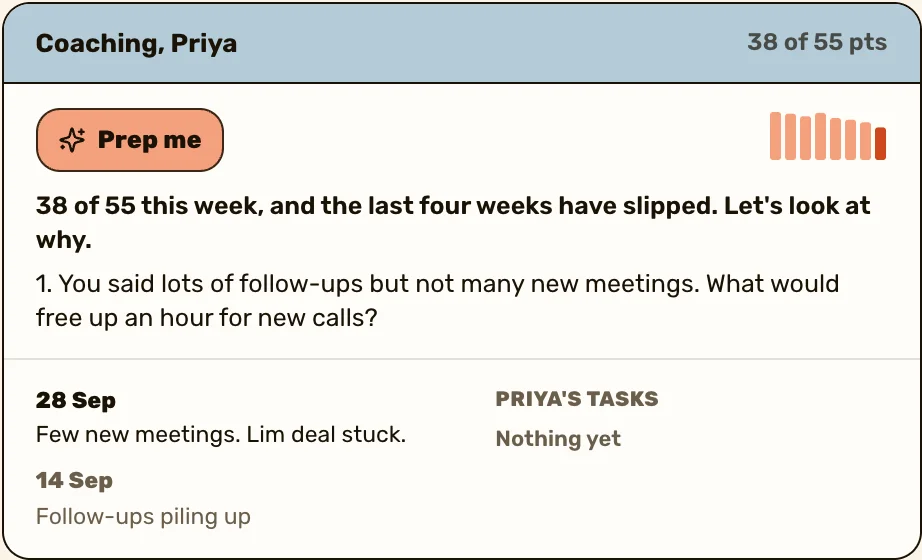
The coaching part is where most small teams slip. ActivityTracker keeps every 1:1's notes on the rep's page, and the action items you tick go straight onto their task list.
See how coaching worksThe content worth writing first
Most enablement guides list a dozen content types, from customer stories to ROI calculators. A small team needs a handful, each ready before a buyer asks for it. Write it in the order buyers ask for it:
| Stage of the deal | What the buyer asks | What to have ready |
|---|---|---|
| Before the first meeting | Who are you, and have you done this before? | A one-page intro and two short customer stories |
| While they compare | How are you different, and what does it cost? | Your ten written answers, a price sheet, a comparison with the usual alternative |
| Before they sign | What happens after I say yes? | A page on the first 30 days, and a customer they can call |
Write the middle row first. That's where deals stall, and it's where a new rep is most likely to guess. Each line in that row should be something a rep can paste into a WhatsApp chat or an email in under a minute.
How to tell if it's working
Watch a few numbers you already have, before and after:
- Time to first deal for new reps, which is your ramp time. Count it from the start date, not from the first call.
- Win rate, rep by rep. A gap between your best rep and the rest is what enablement is meant to close.
- Calls and meetings per rep per week. Training that doesn't change what reps do on the phone hasn't worked yet.
- The questions reps still ask you. If the same one comes up twice, it goes in the folder.
Keep the comparison to your own team, over your own quarters. A figure from another company's survey tells you nothing about your five reps.
Where sales enablement goes wrong
The same mistakes turn up in big companies and small ones. On a small team they're cheaper to fix, because one person can fix all of them:
- The folder fills up with documents nobody asked for. Write for the questions reps get this week, and let the rest wait.
- Training happens once, at onboarding, and stops. One skill a month for everyone keeps it going.
- A tool gets bought and half the team never opens it. If the manager doesn't use it in the 1:1, the reps won't use it either.
- Nobody owns it, so everyone assumes someone else updated the price sheet. Put one name on the folder.
- Old versions hang around. Delete them on the day the new one goes in.
- Sales and marketing tell buyers different stories. On a small team that's the website saying one thing and the reps saying another, and a 15-minute read of the website together fixes it.
Sales enablement tools for a small team
Search for sales enablement tools and you'll find platforms built for companies with an enablement team: content libraries that track which document a buyer opened, academies for training reps, and software that records and scores calls. A small team can cover the same jobs with less:
- Content: a shared drive with one folder, named so a rep can find the document on a phone mid-call.
- Training: a recorded call library and a short written playbook. The cold calling script template is one page to start from.
- Tools reps use every day: a CRM and a way to log calls and meetings, so you're coaching from what happened.
- Coaching: a standing 1:1 with notes that carry over, so next time starts where this one ended.
Buy an enablement platform when you have more content than a folder can hold, and someone whose job is to keep it current.
Where AI fits in sales enablement
AI helps with the two parts that eat a manager's time, practice and review. A rep can rehearse a price objection with an AI buyer before trying it on a real one, and a call summary shows you what happened without listening to the whole recording. Both make a 20-minute 1:1 go further, because you start from the call instead of from memory.
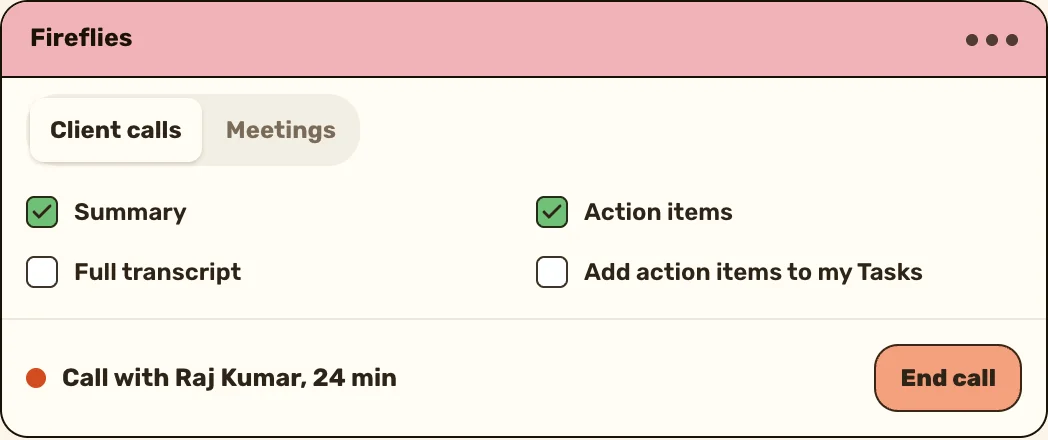
It doesn't replace the written answers. An assistant that answers rep questions needs the ten answers in the folder first, or it makes up its own. Ten minutes of AI sales coaching practice before a 1:1 gives you both something real to talk about.
Sales enablement vs sales training vs sales ops
These three overlap, and at a small company they're often one person.
- Sales training teaches skills, usually in sessions.
- Sales ops runs the systems, like the CRM, territories and reporting.
- Sales enablement covers the whole path from hire to first deal to getting better, and training is one part of it.
If you're the manager of a small team, you're doing all three. The order above, answers first and coaching second, is where the time pays back soonest.
Keep reading
- Sales accountability without micromanagement
- 1 on 1 meeting template
- Weekly sales meeting agenda
- Ramp time
- For sales managers

Questions people ask
Giving reps what they need to sell well: the skills, the answers, the tools and time with a manager. On a small team, the manager does it.
The sales manager or the founder. Guides written for bigger companies give it to sales and marketing jointly, or to product marketing, but on a team of five the person who runs the 1:1s knows what reps are missing.
Where it's a full-time job, the same four parts for a whole sales floor. New reps get an onboarding plan, the content stays current, tools reach everyone and managers learn to coach.
Training teaches skills. Enablement is wider: it also covers the content reps send, the tools they use and the coaching that makes the training stick.
Usually not at first. A shared folder, a CRM, a way to log calls and a regular 1:1 cover the same jobs until you have more content than a folder can hold.
Compare numbers you already have before and after: how long new reps take to close a first deal, win rate by rep, and calls and meetings per rep each week.
Sources
- Dock, What is sales enablement? A modern playbook for GTM teams, read 25 October 2026
- Federico Presicci, Decoding "What is sales enablement?", read 25 October 2026
- Jobstreet, Sales enablement jobs in Singapore, read 25 October 2026