
The difference in two sentences
A chatbot follows paths you set up in advance: it asks the questions you wrote, in the order you wrote them, and gives the answers you wrote. An AI agent uses a language model to understand what someone actually wrote, decides what to do next, and can take an action for you, such as checking your calendar and booking a slot.
Anthropic's guide to building effective agents splits them the same way. A workflow runs a model and its tools along paths written in code ahead of time. An agent directs its own steps and picks its own tools.
The confusion lives in between. Plenty of tools use AI to understand a message and still only answer it.
Three kinds, not two
There are two kinds of chatbot, and the gap between them matters as much as the jump to an agent.
Rule-based chatbot
You build a flow with a greeting, a few buttons or questions, and a set answer for each choice. It asks "Are you looking to buy or rent?", the customer taps "Buy", and the next question is the budget, picked from a set of ranges. It never says anything you didn't write.
It's predictable, cheap and easy to check. It also breaks the moment someone types something off-script, like "hi, is the 3-bed on Elm Street still available and can I see it Saturday?" A rule-based bot usually answers that with its menu.
AI chatbot
This kind uses a language model to understand free text and write replies, usually from your own documents or FAQ. It can answer "do you deliver to the east side on weekends?" in a natural way, even if nobody wrote that exact question down.
What it can't do is act. It answers, then hands over or tells the person what to do next.
AI agent
An AI agent has the understanding of an AI chatbot plus tools it can use and a goal to reach. It can look something up (your calendar, a price list, the customer's record), decide the next step, and do it: book the meeting, update the record, pass the chat to the right person.
It also carries the most risk. Something that can act can act wrongly, so how it's limited matters as much as what it can do. ActivityTracker's WhatsApp AI agent, for example, answers new enquiries in your words, from your website, files and past chats. It offers your free times, books the meeting with a Google Calendar invite and passes you the chat when a person should take it.
ActivityTracker's agent replies from the number you link to it as a device, the way WhatsApp Web works, and it isn't one of WhatsApp's own apps. WhatsApp's linked devices page warns that "linking your device through unofficial apps or websites may put your account at risk." So ActivityTracker spaces out the messages your number starts on its own, and stops them if WhatsApp warns the number.
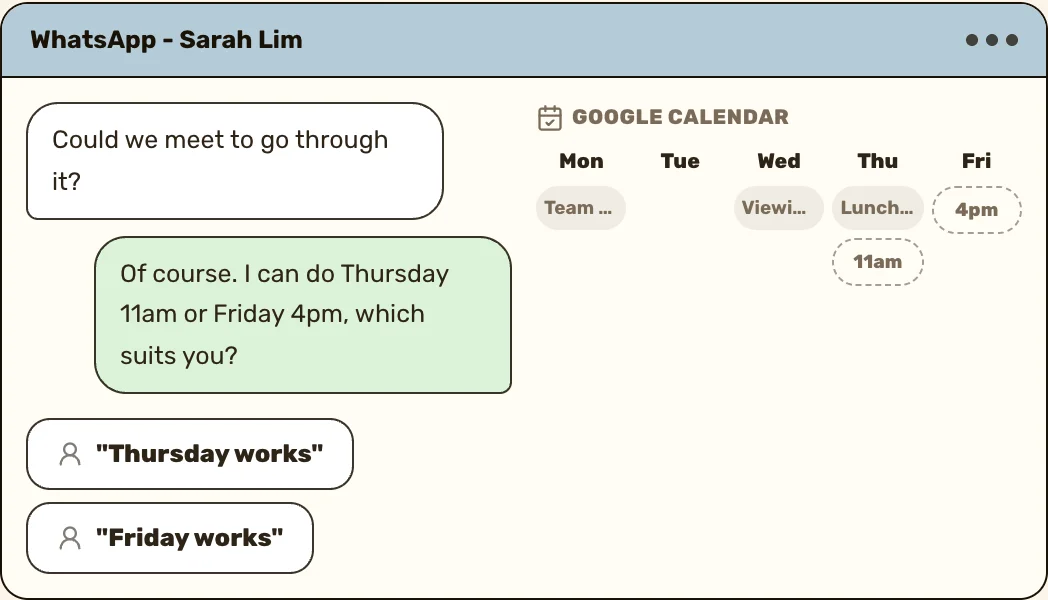
How an AI agent decides what to do
An agent works in a loop. It reads the message, works out what the person wants, uses a tool, checks what came back, and goes round again until the job is done or it needs a person. For an enquiry, one loop looks like this:
- Read: "can I see the flat on Saturday?"
- Decide: they want a viewing, and Saturday is the limit.
- Act: look for free Saturday slots in the calendar.
- Check: 10am and 2pm are free, so it offers both.
- Finish or hand over: book the one they pick, or pass the chat to a person if they ask about the price.
Anthropic's guide recommends the simplest setup that does the job, and adding agent steps only when they're needed, because agents give up speed and cost for better results on harder tasks. It also says an agent should get a real result back from each step, like what the calendar returned, and stop for a person at checkpoints or when it's stuck.
IBM's explainer on agents and assistants adds a test worth keeping: being able to call a tool doesn't make a model an agent. Deciding which tool to use, when, and how to combine them to reach a goal does.
Side by side
| Rule-based chatbot | AI chatbot | AI agent | |
|---|---|---|---|
| Understands free text | Only what matches its keywords | Yes | Yes |
| What it says | Only the lines you wrote | Its own words, from your material | Its own words, from your material |
| Can take actions | Only fixed ones you built into the flow | Rarely | Yes, with the tools you allow |
| Remembers the customer | Within the flow | Usually within one conversation | Can read the customer's record, if connected |
| Setup | Build every path by hand | Load your FAQ and documents | Load your material, connect tools, set limits |
| Risk of saying something wrong | Low, but can be unhelpful | Medium: can make things up | Medium to high: can make things up and act on it |
| Easiest to check | Yes, read the flow | Test with real questions | Test with real questions and check every action |
| Good for | Fixed questions, collecting details, simple routing | Answers to varied questions | Replies and bookings while you're away |
A good rule of thumb: the more the job varies, the more you need the AI side. The more a mistake costs, the more you need rules around it.
Assistants, agentic AI and the five types of agent
You'll also hear two more words: assistant and agentic AI. An AI assistant is the kind you ask for help, like a chat window that drafts a reply or sums up a call. IBM calls assistants reactive: they work when you ask, suggest an action and wait for your go-ahead. Agents are the proactive kind. They plan and act toward a goal, inside the tools and permissions you give them. Agentic AI is the umbrella term for that second kind.
ChatGPT is the example most people know, and the everyday chat is an assistant: you ask, it answers. OpenAI's help centre now points people to ChatGPT Work for longer, multi-step tasks, which is where it starts acting like an agent.
The five types of AI agent
IBM's guide to agent types names five main types, and says all five can work together as one multi-agent system. Here they are, with a sales example for each:
- Simple reflex: follows a fixed rule. The word "brochure" sends the brochure.
- Model-based reflex: keeps track of what already happened. It knows this lead got the brochure yesterday and doesn't send it twice.
- Goal-based: picks steps that move toward a goal. The goal is a booked call, so it offers times instead of only answering questions.
- Utility-based: weighs the outcomes and picks the best one. With two leads waiting, it answers the warmer one first.
- Learning: improves from feedback, like noticing which openers get replies and using them more.
Most tools a small business buys sit in the first three. When a vendor says its agent learns, ask what it learns from and who checks it.
Which fits which job
For a small business or sales team, the choice depends on what the bot or agent is for.
- Collecting the same details from every enquiry (name, what they want, budget, area): a rule-based chatbot. It's reliable and the answers land in the same shape every time. ActivityTracker's chatbot builder works this way on WhatsApp: it greets new chats, asks your questions, saves the answers to their card and books the ready ones.
- Answering varied questions about your products, hours or process: an AI chatbot, trained on material you've checked.
- An AI agent, when you want new enquiries answered at night or while you're busy, with the right questions asked and a meeting booked. This is where a quick first reply matters most; lead response time explains how to measure it.
- Anything involving money, contracts, complaints or advice a professional must give: a person. Use the bot or agent to collect details and hand over. If you sell property, read AI chatbot for real estate agents for what a bot must never promise a buyer.
Made-up example: a small property agency gets 60 WhatsApp enquiries a week, a third of them after 8pm.
Month 1: they set up a rule-based chatbot. It asks buy or rent, budget and area, then says an agent will reply in the morning. It works for people who tap the buttons. A quarter type a question instead, like "is the flat on Park Road pet friendly?", and get the menu back. Several stop replying.
Month 2: they switch to an AI agent, allowed to answer from their listings sheet and to book viewings into two agents' calendars. They set three limits: no price negotiation, no promises about approvals or legal points, and hand over any message that mentions a complaint.
In the first week they read every conversation. The agent books 11 viewings overnight. It gets two things wrong: it tells one buyer a flat has parking when the listing didn't say, and it offers a viewing slot one agent had blocked for lunch. They fix the listing sheet and the calendar settings.
Month 3: they read a sample of 10 conversations each Friday instead of all of them. The morning starts with booked viewings and a short list of handed-over chats, not 20 unanswered messages.
If your enquiries arrive on WhatsApp, ActivityTracker's AI agent works on your own number. It answers new enquiries in your words, books the meeting and passes you the chat when a person should take it.
See the WhatsApp AI agentWill AI agents replace chatbots?
Not soon, and the companies selling agents say so. On Salesforce's own explainer, Abhi Rathna, a product management director on its AI team, expects customer-facing work to stay a mix: scripted bots where a business wants control over every word, and agents where it's happy to let AI run the conversation.
Small businesses land in the same place. A scripted flow is cheap and predictable, and you can check the whole thing in five minutes, so it suits the questions every enquiry gets. Agents are slower and cost more to run, as Anthropic's guide says. Someone has to read their chats. They pay off once the questions vary and the goal is a booking.
So the setups that work end up with three parts: a short scripted flow for the first details, an agent for the conversation after, and a clear handover to a person.
Questions to ask any vendor
Plenty of tools now say "AI agent" on the box. Ask these in the demo, and ask to see it work on your own material rather than their sample:
- What can it actually do, besides reply? Show me it booking a meeting or updating a record.
- What does it answer from? Can I see and edit the material, and what happens when the answer isn't in it?
- What stops it from making things up? Show me what it says when I ask something it doesn't know.
- What actions can I switch off, and which need my approval first?
- How does it hand over to a person, and what does the person see when it does?
- Can I read every conversation, and search them later?
- Which channels does it work on (WhatsApp, website, email), and on which number?
- What does it cost, and is that per conversation, per message or flat? Read the pricing page and check the current price on their site.
- Where is the customer data stored, and is it used to train anyone's model?
A tool that only suggests what to do next is an AI chatbot, whatever the label says. Often that's all you need. Just don't pay agent prices for it.
Then test it. Before customers see it, send it 20 real messages from past enquiries, including the awkward ones: a typo-filled question, an angry message, a request for a discount, a question in a second language, and something it shouldn't answer. Read every reply.
The handover to a person
The handover is where most bots and agents fail customers. Get it right and customers barely notice the switch. Get it wrong and they repeat themselves to a person who has no idea what's been said.
A good handover has four parts:
- A written list of triggers, such as the customer asking for a person, getting frustrated, mentioning a complaint or money, or asking something outside the limits.
- An honest promise. The customer hears that you'll come back to them only when the chat has really been passed on. "Someone will get back to you" followed by silence is the worst version.
- The whole conversation, and anything the agent collected, in front of the person taking over, on the customer's record.
- One named owner for each handed-over chat, with someone checking the handovers each morning.
ActivityTracker's agent never tells a customer someone will get back to them unless it hands the chat over in the same turn. It hands over complaints without arguing, and if someone asks outright whether they're talking to a person, it doesn't lie: it passes the chat to you.
Also decide what happens when nobody's available. An agent that says "I'll reply by 9am" and then nobody does is worse than no agent. Answering leads at night covers replying first, then following through in the morning.
What doesn't work
- Setting it up and never reading the conversations. Both bots and agents drift out of date as your prices, stock and hours change.
- Letting an agent do anything with money or promises without a rule. It will, sooner or later, agree to something you wouldn't. ActivityTracker's agent quotes a price only when that price is written in the material you gave it.
- Lying when asked. If a customer asks whether they're talking to a person, a made-up answer costs more trust than the truth.
- Using a rule-based bot for questions that vary. It frustrates people who just want an answer.
- Automating before you know your own answers. If your team can't agree what to say, the software can't either.
AI sales automation covers the wider picture: what to automate in sales, what to leave to people, and a weekly check for the automations that fail quietly.
What to do first
- Read the last 50 enquiries you got, and sort them: same few questions, varied questions, or needs a person.
- Write down the details you want from every enquiry, and the answers to your ten most common questions.
- Pick the simplest tool that handles most of your enquiries: a rule-based flow if they're mostly the same, an agent if they vary and you want bookings made.
- Write the handover rules and name who gets handed-over chats.
- Test with 20 real past messages, then read every real conversation for the first two weeks.
- After a month, count three things: bookings it made, chats it handed over, and answers you had to correct.
Keep reading

- WhatsApp chatbot builder
- WhatsApp auto reply
- Sales KPI


Questions people ask
A chatbot follows the paths and answers you set up in advance. An AI agent understands free text, decides what to do next and can take actions, like booking a meeting or updating a record.
A rule-based chatbot only says what you wrote and follows fixed buttons or keywords. An AI chatbot uses a language model to understand any wording and write its own replies from your material, but usually can't take actions.
The everyday ChatGPT chat is an assistant you talk to: you ask, it answers. It acts like an agent when it carries out a longer, multi-step task for you, which OpenAI now points people to ChatGPT Work for.
IBM names five: simple reflex, model-based reflex, goal-based, utility-based and learning agents. Most tools a small business buys sit in the first three.
Yes, with limits: only the actions you allow, a clear handover to a person, and someone reading conversations regularly. Keep money, contracts and professional advice with people.
A chatbot is enough if most enquiries ask the same few things. Once they vary and you want bookings made while you're away, you need an AI agent.
Sources
- WhatsApp Help Center, About linked devices, read 26 October 2026
- Anthropic, Building effective agents, read 26 October 2026
- IBM, AI agents vs. AI assistants, read 26 October 2026
- IBM, Types of AI agents, read 26 October 2026
- Salesforce, AI agent vs chatbot: key differences explained, read 26 October 2026
- OpenAI Help Center, ChatGPT agent, read 26 October 2026