
Why the skills that got you promoted aren't enough
You were the rep who closed. That's why you got the job. Now your number is the team's number, and you can't hit it by working harder on your own deals.
That's how most sales managers get the seat. When Gallup asked US managers why they were hired, the usual answers were their success in the role before or their years at the company. The same piece estimates that managers account for at least 70% of the difference in engagement scores from one business unit to the next. The promotion rewards one set of skills, and the job runs on another.
The skills that matter now are about other people's weeks: what they practise, how they spend their time, and whether you can see a bad month coming by the second week. None of them are hard. They're just different, and most new managers pick them up a year late.
What a sales manager does
The US Bureau of Labor Statistics' Occupational Outlook Handbook puts the job in one line: a sales manager plans, directs or coordinates how a product or service reaches the customer. Day to day, that's five duties:
- Set sales goals for each rep and track their progress against them.
- Recruit, hire and train the people on the team.
- Read the team's numbers and project what will close.
- Help reps with presentations and closing, and take the complaints they can't settle.
- Work with marketing and the rest of the business on who to sell to.
O*NET's profile of the job goes further. It counts coaching and developing others as part of the work, and its time management covers other people's hours as well as yours. Job ads boil all of it down to adjectives. Each of those adjectives shows up in a normal week, and one of the seven skills below builds it.
| The job ad says | What it looks like in your week | Skill to practise |
|---|---|---|
| Leadership | Reps bring you a plan, not just the problem | 1. Letting go of their deals |
| Coaching | Each rep can name the one skill they're working on | 2. Coaching one thing at a time |
| Communication | The team meeting ends with names and dates | 3. Running the weekly review |
| Good with numbers | You know which deals to count before your boss asks | 4. Forecasting honestly |
| Organised | Reps' calendars have room for calls | 5. Protecting selling time |
| People skills | The middle reps get the same 1:1 as the top rep | 6. Handling the middle |
| Recruiting | You know what you'd hire for before a seat opens | 7. Hiring |
The seven sales manager skills
1. Letting go of closing their deals
The first skill is the hardest. When a rep's deal wobbles, your instinct is to jump on the call and close it. It works once. Then the rep learns that hard deals go to you, and you've become the team's most expensive closer.
Practise it this quarter: pick one deal a month where you'd normally step in. Instead, prep the rep for 15 minutes before the call and debrief for 15 after. Stay off the call unless the buyer asks for you by name.
2. Coaching one thing at a time
New managers tend to give a rep every piece of feedback at once. After listening to a call you'll spot six things. Hand the rep all six and they'll act on none.
Pick the one thing that loses them the most deals, and work on only that until it's fixed. Usually that takes a month or two. The 1 on 1 meeting template keeps each session on that one skill.
How much help you give depends on the rep. A new rep needs you to walk through each step. An experienced rep needs the goal, some room, and a check-in on the day you agreed. Checking every morning tells a good rep you don't trust them, and they'll stop telling you things.
Practise it this quarter: write one skill per rep on a card. In every 1:1, ask about that skill and nothing else for the first ten minutes, and listen to one of their real calls a week to hear whether it's changing.
3. Running the weekly review
The weekly team meeting is where the team sees whether the week is on track. Run badly, it's an hour of each rep reading their pipeline aloud.
A good one is short and has the same shape every week: last week's numbers, which deals need help, one thing to practise, and who's doing what by Friday. The sales meeting agenda guide has one to start from.
Practise it this quarter: cut the meeting to 30 minutes and send the numbers before it starts, so nobody reads them out.
4. Forecasting honestly
Your boss asks what the team will close this month. The easy answer is the number they want to hear. The useful answer is the number your pipeline supports, even when it's lower.
An honest forecast counts only deals with a real next step booked, and weighs each by how often deals at that stage have closed for your team before. The forecasting post works through the maths.
Practise it this quarter: write your forecast down every Monday, then compare it with what closed at month end. Being wrong in the same direction three months running tells you something.
5. Protecting reps' selling time
Every request from above lands on your reps' calendars: reports, trainings, internal meetings, forms. Part of your job is being the filter.
Ask what your reps spend their week on. Most will tell you the calls and meetings take less of it than they should, and that admin eats the rest.
Practise it this quarter: ask each rep to write down how they spend one week. Then remove one recurring meeting or report from their week, and give the hour back for calls.
6. Handling the middle of the team
New managers spend their time on the top rep, who's fun to talk to, and the bottom rep, who's on fire. The middle of the team gets ignored, and that's where most of your number sits.
The middle reps don't need rescuing. They need regular attention and one skill to work on, the same as everyone else.
Practise it this quarter: book the same length of 1:1 with every rep, on the same rhythm. If one has to go, move the top rep's, because they'll be fine for a week.
7. Hiring
One wrong hire costs you months. There's the time to recruit and the time to ramp, then the time it takes to manage them out. Most new managers hire the person who interviews most like them.
Before you interview, write down what the job needs in the first 90 days. Then test for it. Ask candidates to do a short roleplay of a first call, and ask how they'd plan their first month. The guide to hiring sales reps has the interview questions.
Practise it this quarter: even if you're not hiring, write the job's first-90-days list now. Then run a mock interview with a peer so the questions are ready when a seat opens.
A new manager's week, before and after
Made-up example: Sam was promoted to manage six reps eight months ago. He writes down where his hours go in one normal week. He spends 9 hours on calls with reps' buyers, 6 hours in internal meetings, 5 hours on reports for his boss and 3 hours in 1:1s, which he often cancels when a deal needs him.
Over one quarter he makes three changes. He stays off reps' calls and preps them instead, which takes 4 hours a week. He cuts the weekly meeting from an hour to 30 minutes and sends the numbers first. He books a fixed 30-minute 1:1 with every rep, every week, and stops cancelling them.
By the end of the quarter he spends 4 hours on call prep, 3 in internal meetings and 5 on reports. His 1:1s still take 3 hours. Now they happen every week. Two of his middle reps booked more first meetings than in the quarter before, and neither of them needed Sam on a call to do it. The numbers are invented; time your own week.
Getting ready before the promotion
If you're still a rep and want the job, the BLS handbook says most sales managers have a bachelor's degree and several years in sales first, and some roles take a high school diploma. It puts the US median pay at $148,270 a year in May 2025. Neither tells you whether you'll be good at it. The work does, and you can start on it before anyone gives you the title:
- Coach one newer rep. Listen to one of their calls a week and give them one thing to try.
- Own a target that depends on other people, such as a team push on a new product.
- Learn the team's numbers, not just yours: how many calls it takes to book a meeting, and how many meetings turn into a deal.
- Run the weekly meeting while your manager is away. Afterwards, ask what they'd have changed.
- Ask two reps what helps them and what gets in their way.
A great rep isn't always a great manager, and the reason is the job, not the person. Selling rewards doing it yourself, fast. Managing rewards getting it done through six other people, more slowly. Top sellers do make good managers once they learn that second way of working. Their selling helps when they coach, because they know what a good call sounds like. The weekly review, the forecast and hiring are new to them, and most managers learn those in the seat. If you'll keep some accounts of your own after the promotion, should sales managers sell? covers how to split the week.
Your first 90 days
A 30-60-90 day plan splits your first three months into three jobs, so you don't try to fix everything in week one.
| Days | What you do | Done when |
|---|---|---|
| 1 to 30 | Listen: a 1:1 with every rep, sit in on calls, read the pipeline | You can name each rep's weakest step |
| 31 to 60 | Set the rhythm: the weekly review, fixed 1:1s, one skill per rep | No 1:1 has been cancelled for two weeks |
| 61 to 90 | Forecast and clear: a Monday forecast, one meeting or report removed | You've compared a month's forecast with what closed |
Leave the commission plan, the territories and the CRM alone in the first month. You don't know yet which problems are real, and the reps are still working out what kind of manager you are.
Check yourself once a month
Once a month, answer these questions honestly. Write the answers down, so you can compare them next month.
- How many of my reps' deals did I close myself this month? The target is zero, or close to it.
- Can every rep tell me the one skill they're working on?
- Did every rep get their 1:1, the middle reps too?
- How far was my forecast from what closed, and was it too high or too low?
- What did I remove from my reps' week this month?
- If a rep quit tomorrow, do I know what I'd hire for?
If you can't answer one, that's the skill to work on next month. The overall verdict sits with your reps. You're doing the job when more of them hit their number, each can name the skill they're working on, and your forecast lands closer to what closed than it did last quarter. The sales accountability guide covers how to hold reps to their numbers without breathing down their necks, which is the same thing you're doing for yourself here.
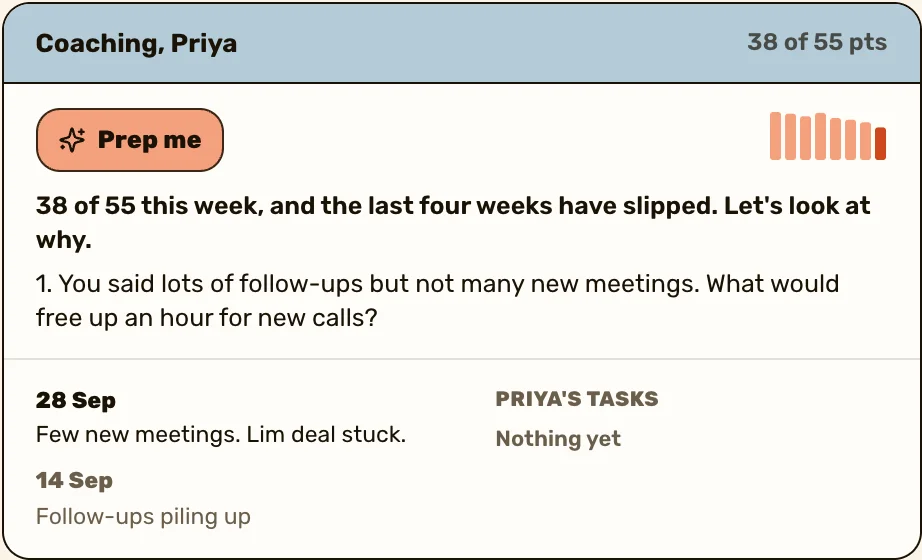
Most of these skills start with seeing the week clearly. With ActivityTracker, reps log calls in one tap, and you see who's gone quiet, read their Friday check-ins and prep each 1:1.
See it for sales managersWhat doesn't work
- Managing by the monthly number alone. By the time the month is over, it's too late to help.
- Trying to be every rep's friend. They need a manager who tells them the truth about their calls.
- Copying your old manager's style. Take what worked for you, and drop what didn't.
- Watching every rep the same way. The new rep needs more of you, and the experienced one needs less.
- Waiting for training from your company. Most new sales managers get none, so start with the practice above.
Keep reading


- 1 on 1 meeting template
- Sales accountability without micromanagement
- Weekly sales meeting agenda
- Sales team motivation


Questions people ask
Letting reps close their own deals, coaching one thing at a time, running the weekly review, forecasting honestly, protecting reps' selling time, handling the middle of the team, and hiring.
Yes, once they learn to get results through other people. Their selling helps when they coach. The weekly review, honest forecasts and hiring are new, and most managers learn them in the seat.
Letting go of closing deals yourself. It feels faster to step in, but it teaches reps to hand you the hard ones and stops them getting better.
It splits your first three months into three jobs: listen to every rep for the first 30 days, set the team's weekly rhythm in the next 30, then forecast and clear time-wasting meetings or reports in the last 30.
Pick one skill per rep, work only on that in every 1:1 until it improves, and listen to one of their real calls a week to see whether it has.
Look at your reps. If more of them hit their number, they can each name the skill they're working on, and your forecasts are getting closer, you're doing the job.
Sources
- U.S. Bureau of Labor Statistics, Occupational Outlook Handbook: Sales managers (what they do, how to become one, pay), read 26 October 2026
- O*NET OnLine, Sales managers 11-2022.00 (work activities and skills), read 26 October 2026
- Gallup, Why great managers are so rare (why managers say they were hired, managers and engagement), read 26 October 2026