
What MEDDIC is
MEDDIC is a sales qualification framework: six things you find out about a deal, one per letter, so you know whether it's real and what's missing if it isn't.
- M: Metrics
- E: Economic buyer
- D: Decision criteria
- D: Decision process
- I: Identify pain
- C: Champion
It came out of enterprise software sales in the 1990s, where deals had several people involved and months between first call and signature, and it still fits that kind of deal best.
The point of MEDDIC is the gaps. A deal where you can fill in all six is one you can put in a forecast, while a deal where you can't name the economic buyer three weeks before it's meant to close is one to worry about now.
The six letters, and the question each one asks
| Letter | What you need to know | A question to ask the buyer |
|---|---|---|
| Metrics | The result they want, in numbers: time saved, cost cut, revenue added | "If this works, what number changes, and by how much?" |
| Economic buyer | The person who can say yes to the money, and can say no when everyone else says yes | "Who signs off on a spend like this?" |
| Decision criteria | What they'll judge options on: price, features, support, fit with what they use | "What will you compare the options on?" |
| Decision process | The steps from here to a signed contract, who's involved in each and the dates | "What happens between now and a signed agreement?" |
| Identify pain | The problem costing them enough to act on, and what happens if they don't | "What happens if you leave this as it is for another year?" |
| Champion | Someone inside who wants you to win and will sell for you when you're not in the room | "Who else would want this fixed as much as you?" |
Ask them in a conversation, never as a list read out in one go. Most come up naturally in a good discovery call, and MEDDIC is how you notice the ones that didn't.
Deeper questions for each letter
One question per letter gets you started. When the first answer is vague, these go a layer deeper:
Metrics: How do you measure this today? What number would tell you it worked, and by when?
Economic buyer: Who signed off the last purchase like this one? Will they see the proposal before it's agreed?
Decision criteria: What has to be true for you to say yes? Is there anything that rules an option out straight away?
Decision process: Walk me through what happens after you recommend it. Who else reads the proposal, and when?
Identify pain: What have you tried already? Who loses the most if nothing changes this year?
Champion: Can you set up 20 minutes with the person who signs? What do the others think of the idea so far?
The answer matters more than the question. Some answers sound like progress and tell you nothing:
| Letter | Sounds fine | Means you know it |
|---|---|---|
| Metrics | "It'll save us loads of time" | "Rebooking takes 10 hours a week per clinic, and we want it under 5" |
| Economic buyer | "I'll take it to the owners" | You've met the owner, or you have a date to |
| Decision criteria | "We just want the best option" | Three named things they'll compare, in their order |
| Decision process | "We'll decide soon" | Each step, who's in it and the date it happens |
| Identify pain | "Things aren't great" | A cost they've named, and what happens if it stays |
| Champion | "She loved the demo" | She booked you a meeting you couldn't have got alone |
You'll rarely learn the letters in the order of the name. Pain and metrics usually come first, since they give you the right to ask who signs. The process and the paperwork come last.
A deal worked through
Made-up example: a rep is selling scheduling software to a group of eight physio clinics. The deal is in the pipeline at $48,000 a year, with a close date next month. Here are her MEDDIC notes after two calls:
- Metrics: front desk staff spend 10 hours a week on rebooking at each clinic. Their operations manager wants that halved.
- Economic buyer: unknown. The operations manager "will take it to the owners".
- Decision criteria: works with their current booking system, sends text reminders, price under their budget.
- Decision process: unclear. Operations manager recommends; after that, "the owners decide".
- Identify pain: no-shows at two clinics went up this year and patients complain about waiting on hold to rebook.
- Champion: the operations manager, who asked for the demo and is keen.
Two letters are thin, and they're the two that decide whether this closes next month. The next call isn't another demo. It's asking the operations manager to set up 20 minutes with one of the owners, and to walk through what happens after she recommends it.
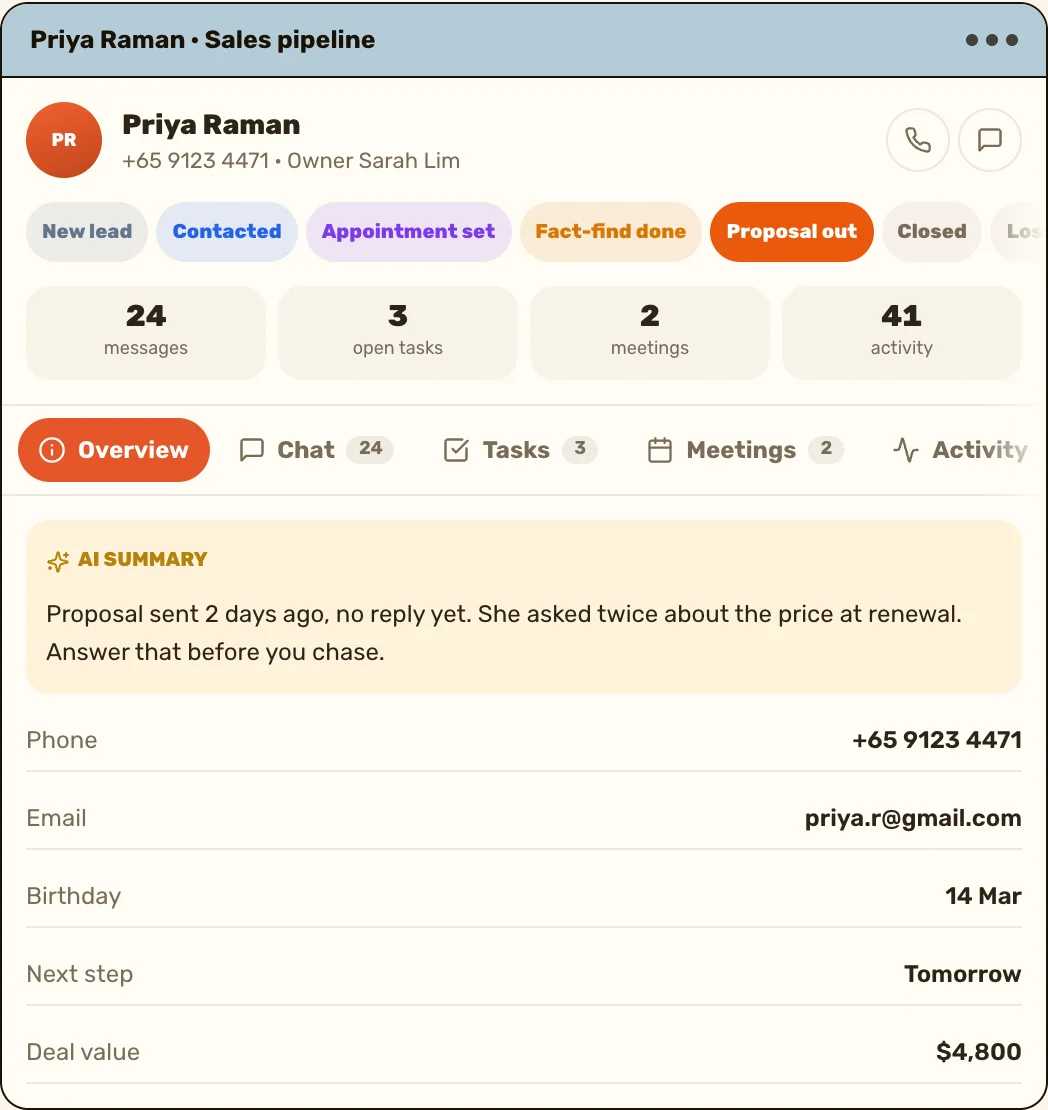
Without MEDDIC, that deal looks healthy: a keen contact, a good demo and a date. With it, the rep can see the deal hasn't met the person who signs.
What MEDDIC gets you
Teams take up MEDDIC for one reason: deals stop surprising them. That shows up in four places:
- The forecast. A deal counts when its letters are filled, not when the rep feels good about it, so your forecast rests on facts. How to forecast sales covers the rest of that sum.
- Earlier walk-aways. An unknown economic buyer in week two is a question to ask. In week ten, it's a lost quarter.
- Sharper 1:1s. "Which letter is thin?" gets a better answer than "how's it going?", and every rep answers it the same way.
- Cleaner handovers. When a rep leaves or goes on holiday, the next person reads six lines and knows where the deal stands.
None of this needs new software. It needs the same six lines, kept up after every meeting with the buyer.
How to use MEDDIC without slowing your reps down
The complaint about MEDDIC is that it turns into 30 required fields nobody fills in honestly. It doesn't have to:
- Use it on the deals that need it. Set a size or a length of sales cycle above which a deal gets MEDDIC notes. A one-call sale doesn't need six letters.
- One line per letter. If a rep can't write the economic buyer in one line, that's the finding.
- Update it after each meeting with the buyer, not once a week from memory.
- Mark each letter known, partly known or unknown. A deal with two unknowns a month before close is a conversation for the 1:1.
- Talk about it in the 1:1, not in a form. Pick one open deal, walk the six letters, and agree the single next thing to find out.
The manager's job is to ask "how do you know?", not to fill the gaps in for the rep. "The champion is keen" and "the champion booked me a meeting with the owner" are different answers.
MEDDIC works best as a 1:1 habit: walk one open deal letter by letter and agree what to find out next. ActivityTracker keeps each session's notes on the rep's page and sends the action items to their task list.
See how coaching worksWhen to walk away from a deal
MEDDIC also tells you when to stop. Take a deal out of the forecast when you see any of these, and put it on a slower follow-up list with a date to look again:
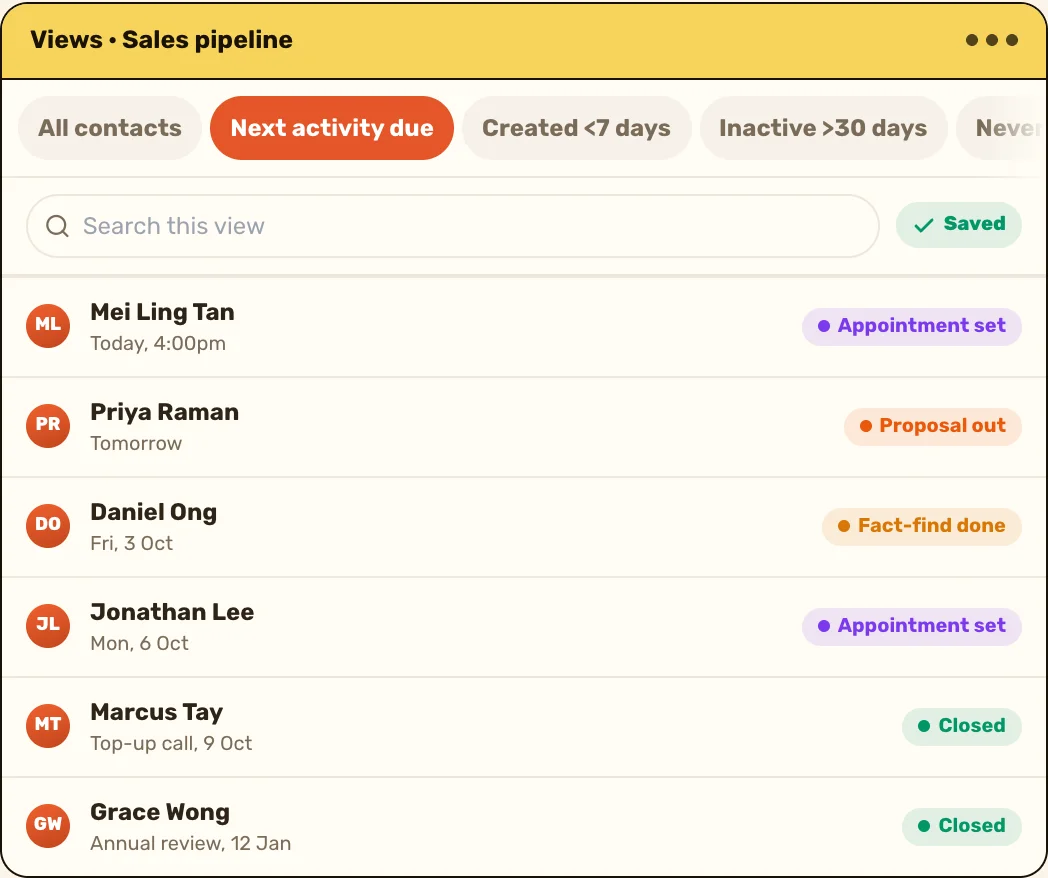
- Two real conversations in, nobody can name what the problem costs them.
- You've asked to meet the economic buyer three times and been turned down three times.
- Your contact is friendly but won't do anything for you: no introductions, no inside view.
- The criteria read like a rival's spec sheet.
- Nobody on their side can tell you what happens next, or when, even after you've asked them straight.
Every deal you drop gives its hours to one that can close. The sales pipeline management guide shows how to keep those parked deals from cluttering the weekly review.
Rolling MEDDIC out to a small team
You don't need a training programme to start, just four weeks and one deal per rep:
- Week 1: agree which deals get MEDDIC notes, by size or by how many people the buyer has involved, and give anything below that line three quick questions instead.
- Week 2: every deal above the line gets its six lines, each marked known, partly known or unknown, in the notes field you already have.
- Week 3: in each 1:1, walk one deal letter by letter and agree the one thing to find out next, written down as a task with a date. The 1 on 1 meeting template has room for it.
- Week 4: look across the whole team, and whichever letter is unknown most often, train everyone on that next month.
After that, keep it in the 1:1s and out of the weekly report. A report turns six honest lines into six boxes to tick.
MEDDIC, MEDDICC and MEDDPICC
Some teams use a longer version. Each one adds a letter for something teams kept getting caught out by:
| Version | What it adds | Use it if |
|---|---|---|
| MEDDIC | The six letters above | Most deals with several people and a cycle of weeks |
| MEDDICC | A second C, Competition: other vendors, building it in-house, or doing nothing | Buyers always compare you with someone |
| MEDDPICC | P, Paper process: the legal and buying steps before anyone signs | Deals slip past quarter end waiting on contracts |
MEDDIC Academy's history of the framework points out that both were inside the original six all along: the paperwork was part of the decision process, and competition sat in the criteria and the process. The extra letters stop teams skipping them. If your deals rarely stall in legal or lose to a rival, stay with six letters.
MEDDIC or BANT?
BANT is the shorter check: budget, authority, need and timing. It's built for the first call, to decide whether a lead deserves a second one. MEDDIC runs the whole length of the deal.
| BANT | MEDDIC | |
|---|---|---|
| When you use it | The first call or two | From discovery to signature |
| Money | Is there a budget? | What's it worth to them, in their own numbers? |
| People | Is this the person who decides? | Who signs, who decides, and who's selling for you inside? |
| How they buy | When do they want it? | The steps to a signed contract, with names and dates |
| Best for | Short sales with one buyer | Long deals with several people |
Use both. BANT decides whether a lead is worth a meeting, and MEDDIC takes over once it is. How to qualify prospects has the first-call questions.
When MEDDIC is too much
MEDDIC earns its time on deals with several people involved and a cycle of weeks or months. It's too much for:
- Sales closed on the first or second call, where one person decides.
- Small, repeat purchases where the price is fixed.
- A rep's first week, when they're still learning the product.
For those, three questions cover it: do they have the problem, can they pay, and will they decide soon? Save the six letters for the deals that make or break your quarter.
Where MEDDIC came from
MEDDIC came out of PTC (Parametric Technology Corporation), a Boston software company, in the 1990s. The history of MEDDIC and MEDDPICC by Darius Lahoutifard, who was in PTC's international sales leadership team and later founded MEDDIC Academy, says the habits grew in the field in the early 1990s and were put into the six-letter form across 1995 and 1996.
Who invented it depends on who you ask, and the people who were there disagree. Jack Napoli, interviewed in 2023, says Dick Dunkel wrote the six elements on a whiteboard while the two of them went through won and lost deals, and he calls Dunkel its father. John McMahon, who helped build PTC's US sales team, says nobody sat in a room and came up with it: it grew one solved problem at a time. Both accounts put its start in real deals rather than a classroom.
Two of the PTC people later wrote books around it: Lahoutifard's Always Be Qualifying in 2020, and McMahon's The Qualified Sales Leader in 2021.
Keep reading
Questions people ask
Metrics, Economic buyer, Decision criteria, Decision process, Identify pain and Champion. Know all six before you count on a deal.
A qualification framework. It sits inside your sales process and tells you, at any stage, what you still don't know about a deal.
BANT checks budget, authority, need and timing on the first call or two, to decide if a lead deserves a meeting. MEDDIC runs through the whole deal and adds how the buyer decides and who's selling for you inside.
MEDDPICC adds two letters: P for paper process, the legal and procurement steps, and a second C for competition. Use it when deals stall waiting on contracts or buyers always compare you with someone.
It's more than a one-call sale needs. Use it on deals with several people involved and a longer cycle, and ask three simple questions on the rest.
Nobody agrees on one person. It came out of PTC's sales team in the 1990s: Jack Napoli credits Dick Dunkel with writing it up, while John McMahon says it grew in the field over years.
Sources
- Darius Lahoutifard, MEDDIC Academy, History of MEDDIC and MEDDPICC, read 25 October 2026
- MEDDIC Academy, MEDDIC and MEDDPICC training and certification, read 25 October 2026
- MEDDIC Academy, Always Be Qualifying (the book), read 25 October 2026