
What a consulting proposal is for
You've had the discovery call. The client liked you and asked you to "send something over". The proposal's job is to turn that into a yes before the feeling wears off.
It isn't a brochure about you. It's a short document that proves you listened, says what you'll do and what it costs, and makes the next step obvious. Most one-person proposals run two to four pages. If yours is longer, the client will skim it, and the part they skip is usually the price.
Write it the same day, from your call notes
The best time to write a proposal is within a few hours of the call, while you still remember how the client said things. Three days later you'll write in your own words, and the proposal will sound like everyone else's. If the call ends late, send it the next morning at the latest, while the client still remembers why they wanted to talk.
During the call, write down four things:
- The problem, in the exact words they used. "Our leads go cold after the first meeting" beats "pipeline conversion issues".
- What it's costing them: time, money, a missed target, a stressed team.
- What good looks like to them in three or six months.
- Who else has to agree, and when they decide.
If you talk your notes into your phone afterwards, a notes app that turns voice into text saves you retyping. Then block an hour that afternoon and fill in the template below from those notes.
For a bigger job, check your understanding before you write the whole thing. Send the client five lines the same day: the problem as you heard it, what good looks like, your rough approach, the budget range they gave and who else decides. Ask "Have I got this right?", and write the proposal once they say yes. It costs a day, and it saves you a polished proposal that answers the wrong question.
The consulting proposal template, section by section
Change everything in brackets. Cut any line that isn't true for this client.
The top of the page
Proposal for [client name], [company]
Prepared by [your name], [your business]
Sent on [date]. This proposal holds until [date].
The hold date gives the client a reason to decide, and gives you a way out if your diary fills up in the meantime.
1. Their problem, in their words
[Client name], thanks for the time on [day].
Here's what I heard. [Company] is [where they are now, in one line]. The problem is [the problem, in their words]. Right now that means [what it's costing them], and it's [person or team] who feels it most, because [one line on why].
By [month], you'd like [what good looks like to them].
If I've got any of that wrong, tell me before we go further.
This section does more selling than any other. When a client reads their own words back, they know you listened.
2. What you'll do
Here's how I'd get you there.
1. [First step: what you'll look at or do, and with whom]
2. [Second step: what you'll build, change or run]
3. [Third step: how you'll hand it over so it keeps working]
I'll need [what you need from them: access, a contact, an hour a week], by [date].
Keep it to three to five steps. Name what you need from them and when, so there are no surprises in week two.
3. What they get
At the end, you'll have:
- [Deliverable 1: something they can hold, like a document, a working system or a trained team]
- [Deliverable 2]
- [Deliverable 3]
We'll know it's worked if [one measurable sign, in their terms].
Not included: [what they'd assume is in, like extra workshops or work for another team]. I'm happy to quote for those separately.
A deliverable is something they can point to when you leave, like a written sales process the team actually uses. A run of workshops is an activity, and it's hard to say yes to an activity. The "not included" line stops the edges of the job turning into free work later.
4. Timeline
Week 1: [what happens]
Weeks 2 to 3: [what happens]
Week 4: [what happens, and what they have by the end]
If we start on [date], you'll have [main deliverable] by [date].
Tie the end date to something they care about, like the start of a quarter or a launch.
5. Price, as options
There are three ways to do this.
Option A, [name]: [what's included]. [Price].
Option B, [name]: everything in A, plus [what's added]. [Price].
Option C, [name]: everything in B, plus [what's added]. [Price].
Most clients in your position pick B, because [one reason tied to their problem].
Payment: [half on signing, half on handover], invoiced by email and due within [number] days.
Always put the price in, because a proposal without one just starts another round of emails. Two or three options let the client choose between yeses instead of deciding yes or no. Put the one you'd recommend in the middle and say why. Don't list your hourly rate. Price the result.
6. What happens next, and how to say yes
To go ahead:
1. Reply to this email with the option you'd like.
2. I'll send the agreement and first invoice the same day.
3. We'll start on [date] with a [length] kick-off call.
I can start on [date] if I hear from you by [date]. After that, my next opening is [date].
[Your name]
Give a real date for the decision. An open-ended proposal gets an open-ended answer.
Extra sections for a bigger job
Those six sections cover most one-person projects. A larger job, or one a committee will read, needs a few more. Add each one only when its reason applies:
| Section | Add it when | What goes in |
|---|---|---|
| Summary at the top | Someone who wasn't on the call reads it first | The problem, what you'll deliver, the timing and the price, in four lines |
| Why me | They found you cold, or they're comparing three firms | One past result like theirs, or the fact that makes you the safe choice |
| Return on the fee | The buyer has to justify the spend to a boss | Their own numbers from the call: what the problem costs now, against your price |
| Terms | No separate agreement will follow | Payment dates, how changes to the scope are priced, and how either side can stop |
Two of them need wording you can copy:
Summary: [Company] is losing [cost, in their words] because [problem]. Over [length], I'll [what you'll do], and you'll finish with [main deliverable]. The fee is [price], and we can start on [date].
Return on the fee: you told me [the problem] costs you [their number] each [month or quarter]. The fee is [price], so the work has paid for itself once [one plain measure, such as two more clients a quarter].
Keep the terms to plain lines a client can read in a minute. Anything that needs a lawyer belongs in the agreement.
Fixed fee, phases or a monthly retainer
Before you write the price options in section 5, decide how you'll charge, because it changes how you write the scope:
| How you charge | How it works | Suits | Watch for |
|---|---|---|---|
| Fixed fee | One price for a defined result | A clear, short job | Extra requests eat your margin, so fill in "not included" |
| In phases | A price per stage, each agreed before it starts | A long job, or a client nervous about committing | They stop after phase one, so make it useful on its own |
| Monthly retainer | A set fee for an agreed amount of your time each month | Ongoing advice | Write what a month includes, or small questions fill your week |
Day rates sit badly in a proposal, because the client starts counting your days instead of the result. If you think in days, quote the total. When a client pushes back on price, take something out of the scope rather than cutting the fee for the same work.
One proposal, from the call to a yes
Made-up example: Maya, a sales process consultant, has a discovery call at 10am on Tuesday with the founder of a 12-person software company. "We book plenty of demos, but they just stop answering after," he tells her, and his board wants a better quarter by April.
At 2pm she opens her voice notes and writes the proposal in an hour. Her first section uses his exact words. She offers three options: a two-week review with written fixes, the review plus four weeks of coaching his two reps, or both plus a monthly check-in until April. She recommends the second.
She sends it at 3:30pm with a decision date of Friday week and a start date the Monday after that. On Thursday she follows up with a short answer to the one question he asked on the call, and on Monday he replies to pick the middle option.
Format and length: what to send
Write it wherever you write everything else, then send a PDF so the layout holds and nobody edits your numbers. In Google Docs that's File, then Download, then the PDF file type. In Word on Windows it's File, then Save a Copy, with PDF picked from the list.
- Length: two to four pages for one-person work, with the price on page one or two rather than the last page.
- Phone check: open the PDF on your own phone before you send it, because a client between meetings reads it there first.
- Slides: only when you'll walk them through it live. Send the PDF straight after, since slides read thin when they're forwarded.
- File name: "[Client] proposal, [month year]", so they can find it in their inbox a week later.
What to leave out
- Your life story. One line on why you're right for this, or a single past result, is enough. They already chose to talk to you.
- A description of their company back to them. They already know it, so spend those words on the problem.
- Every method you know. List what you'll do for this client, nothing more.
- Legal terms in the body. Put them in the agreement you send after they say yes.
- Jargon they didn't use on the call. If they said "leads go cold", don't write "pipeline attrition".
- Round-number guarantees. "Double your sales" invites a no from anyone careful with money.
When the client sends an RFP instead
Sometimes the client writes first. An RFP, a request for proposals, is the buyer's own document: what they need, the terms they expect and how they'll score the replies. The US government's Federal Acquisition Regulation says an RFP for a competitive purchase has to set out the requirement, the expected terms, what each proposal must contain and the factors used to judge it, and larger companies borrow the same shape.
Answer one differently from a proposal you write after a call:
- Answer in their order and under their headings, even when yours would read better. The person scoring it is working down a list.
- Treat the deadline and the format rules as part of the test, and meet every one of them.
- Ask your questions in the window they give you, and ask early. One sharp question shows you've read it closely.
- Reuse this template for the substance: their problem in their words, your plan, the deliverables, the timeline and the price.
If an RFP arrives with no conversation behind it, ask for a 20-minute call before you write a word. It tells you whether the job is real or the request is there to make up the numbers.
How and when to follow up after sending
A proposal that goes quiet usually isn't a no. The client got busy, or someone else has to read it first, so plan every follow-up before you press send:
| When | What to send |
|---|---|
| Day 2 or 3 | A short note that adds one useful thing: an answer to a question from the call, or a relevant example |
| Day 6 or 7 | A question they can answer in a line, like "Is option A or B closer to what you need?" |
| The decision date | A reminder of the start date you're holding, and when your next opening is |
| Two weeks after that | A polite close: "I'll assume the timing isn't right and take this off my list. Happy to pick it up whenever suits." |
The follow-up email templates post has wording for each of these. Put every date into your diary or a task list with reminders the moment you send the proposal, because the chase is the part most solo sellers forget.
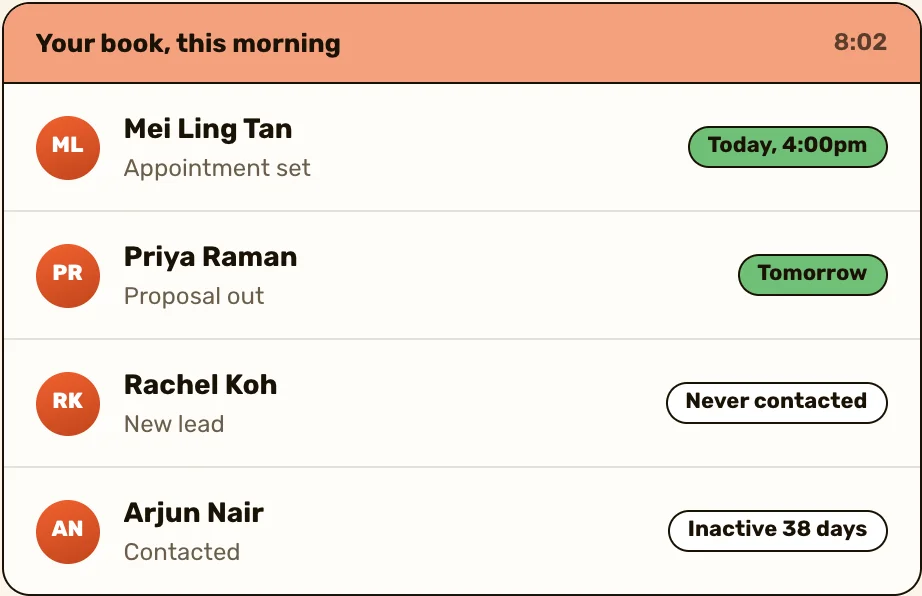
Sending it is half the job. ActivityTracker keeps every proposal you owe a chase on today's list, and logs each discovery call in one tap.
See it for consultantsKeep reading
Questions people ask
Two to four pages for most one-person projects. Longer proposals get skimmed, and the price is what gets missed.
Yes. Give two or three options with a price each and say which one you'd pick. A proposal without a price just starts another round of emails.
The same day, or the next morning at the latest. You'll remember the client's words, and they'll still remember why they wanted to talk.
Follow up on day 2 or 3 with something useful, then again on day 6 or 7 with a one-line question. Close the loop politely two weeks after the decision date.
Keep the six sections the same and rewrite the words every time. Section one has to use this client's own words, or the whole thing reads like a form letter.
A request for proposals: the client's own document setting out what they need, the terms they expect, what each reply must include and how replies will be judged. Answer it in their order, under their headings and by their deadline.
Sources
- Google Docs Editors Help, Create, view, or download a file, read 25 October 2026
- Microsoft Support, Save or convert to PDF or XPS in Office desktop apps, read 25 October 2026
- Acquisition.gov, FAR 15.203 Requests for proposals, read 25 October 2026